
The most practical winter motorhome route from Germany to Spain runs down through France (Alsace or Burgundy, the Rhône valley and Languedoc), crosses into Spain at La Jonquera and follows the Mediterranean coast to Andalusia. From Frankfurt, Cologne or Stuttgart it's roughly 2,200–2,350 km to the Costa del Sol, which you can comfortably cover in five days of 400 to 550 km. Once you arrive, the Axarquía and Torrox-Costa offer mild winters to stay for weeks or months.
It's the question we hear most at reception in early autumn, in German: Wohnmobil Route nach Spanien, or how to go mit dem Wohnmobil nach Spanien im Winter without spending the whole trip behind the wheel. Here you'll find real distances, a suggested split into stages and what France, Switzerland and Spain require of a motorhome.
Distances on the motorhome route from Germany to Spain
Road distances to Torrox-Costa via the fastest route, with non-stop driving times. In a motorhome, add 10 to 20%.
| Exit | Distance to Torrox-Costa | Non-stop driving | Recommended days |
|---|---|---|---|
| Hamburg | about 2,690 km | about 28 h | 6 |
| Cologne | about 2,270 km | about 24 h | 5 |
| Frankfurt | about 2,255 km | about 23 h 30 min | 5 |
| Stuttgart | about 2,190 km | about 23 h | 5 |
| Munich | about 2,300 km | about 24 h 40 min | 5-6 |
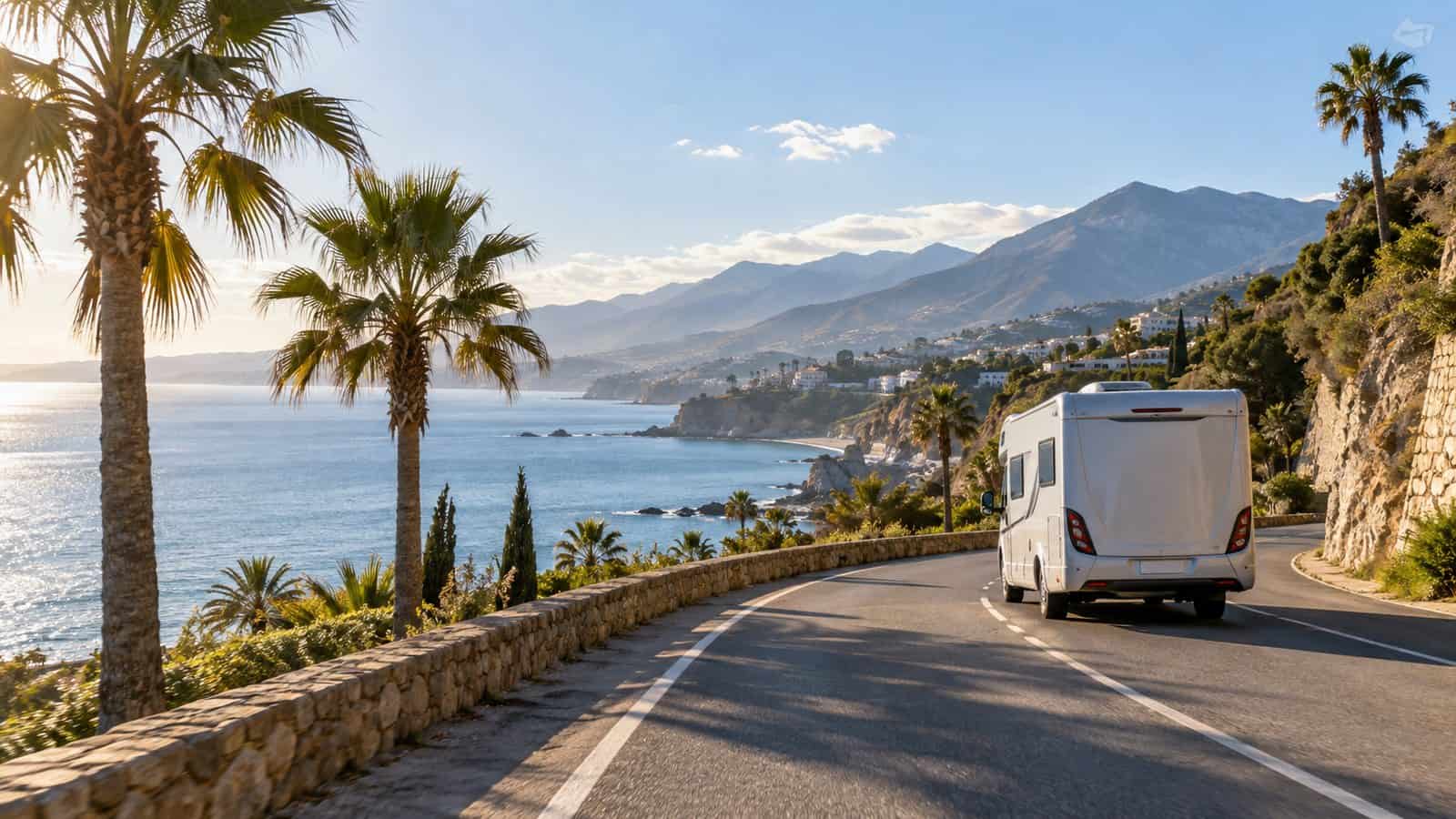
Three ways to head south
Through France and along the Mediterranean coast (the most popular)
You enter France via Strasbourg, Mulhouse or the Saarland, head down to Dijon and Lyon, follow the Rhône to Avignon, turn towards Montpellier and Narbonne and cross the Pyrenees via Perpignan and La Jonquera. From there the Mediterranean motorway takes you past Tarragona, Valencia, Alicante, Murcia and Almería. It's the fastest option from almost anywhere in Germany and, in winter, the one with the fewest mountain passes.
Through Switzerland
From Bavaria or Baden-Württemberg, many people enter via Basel and leave via Geneva towards Lyon. It saves a few kilometres, but it comes at a cost: the Swiss motorway vignette for vehicles up to 3.5 t and, above that weight, the flat-rate heavy vehicle charge (PSVA), which is paid per day even if the motorhome is parked on a campsite. Check prices and conditions with the Swiss Federal Office for Customs and Border Security (BAZG).
Via the west: Bordeaux and Madrid
From northern Germany, some drive down through Belgium, Paris and Bordeaux, cross the border at Irún and go over the central plateau via Madrid. The distance is similar, but in midwinter the plateau and the Somosierra pass can have snow and ice. If you choose this option, check road conditions with the DGT before setting off each day.
Suggested stages from Frankfurt
A five-day split via France and the coast, designed so you drive in the morning and arrive mid-afternoon in daylight:
- Frankfurt – Dijon: about 530 km (5 h 30 min). Into France via Alsace.
- Dijon – Avignon: about 420 km (4 h 40 min) through the Rhône valley. This is where you start to notice the change in climate.
- Avignon – Tarragona: about 530 km (6 h) via Narbonne, Perpignan and La Jonquera. The longest stage; if you're short on energy, split it at Narbonne.
- Tarragona – Alicante: about 430 km (5 h) with a stop in Valencia.
- Alicante – Torrox-Costa: about 450 km (5 h) via Murcia, Almería and the Costa Tropical.
In total, about 2,350 km. If you're in no hurry, add a sixth day and spend the night in Murcia or Almería: the last stage drops to two hours and you arrive rested.
Stops worth making along the coast
Valencia
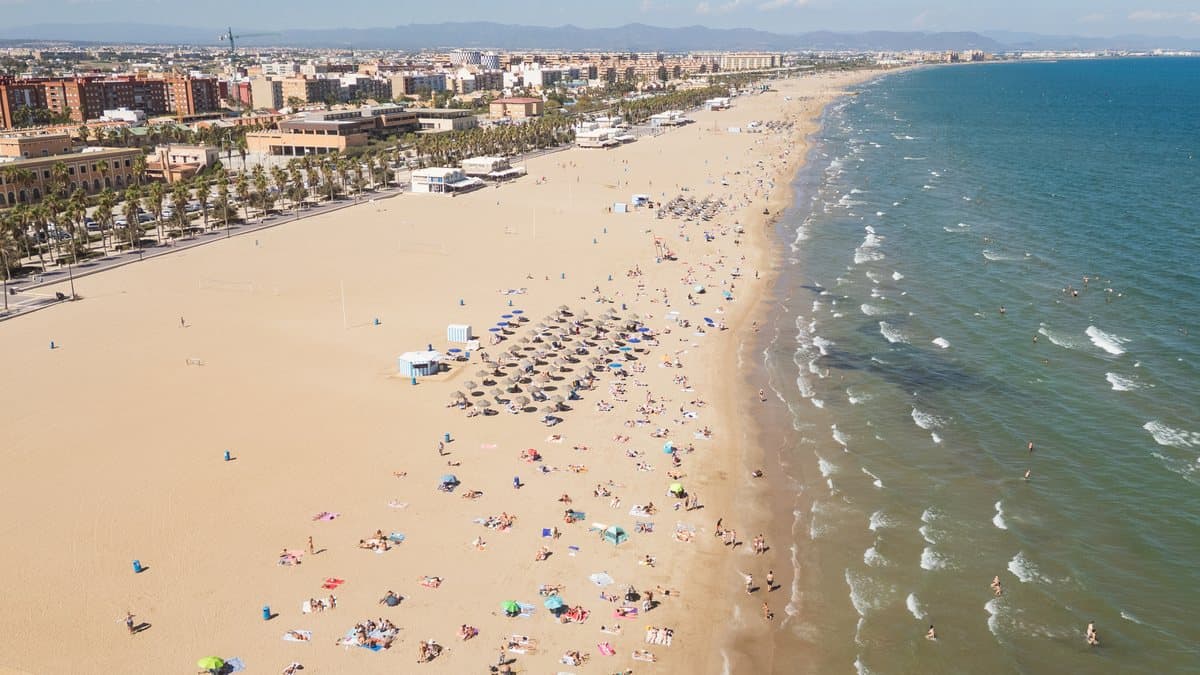
Halfway along the Spanish leg, Valencia is a good excuse to stretch your legs: long city beaches, the old Turia riverbed turned into a park and the City of Arts and Sciences. Don't take the motorhome into the historic centre; park outside and go in by public transport. Information at Visit València.
Almería and its Alcazaba
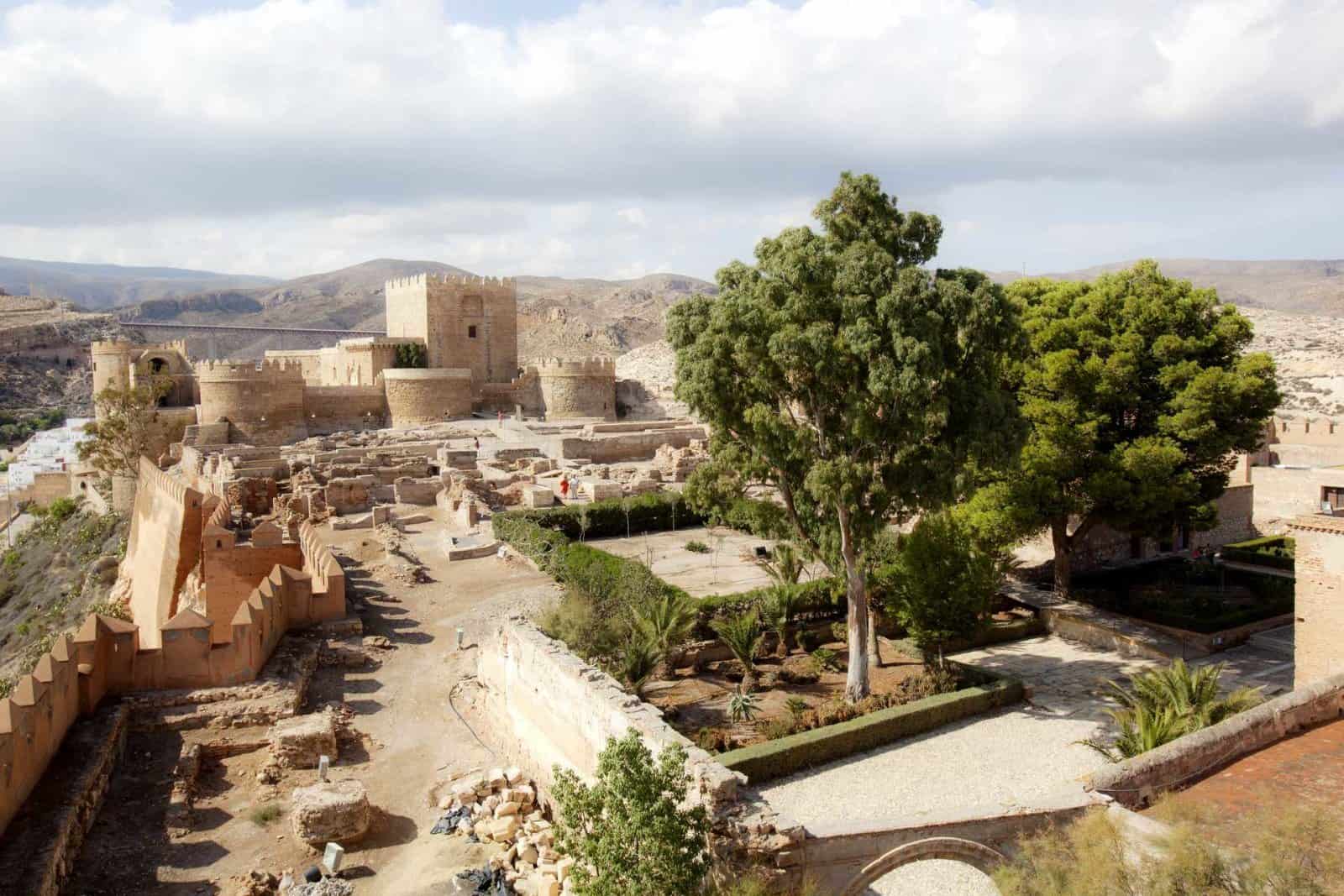
Now in Andalusia, Almería is about 155 km from Torrox-Costa. The Alcazaba towers over the city and in winter you can visit it in sunshine and without the crowds. Nearby is the Cabo de Gata-Níjar Natural Park, about 40 km from the city, if you fancy a couple of days of coves before the final stage.
What each country requires
France
- Tolls. French motorways are tolled. A motorhome over 2 m and under 3 m high and up to 3.5 t pays class 2; at 3 m or more, or over 3.5 t, class 3. This is explained by Vinci Autoroutes, which operates much of the route.
- Crit’Air. Some French cities have low-emission zones (ZFE) that require the Crit’Air sticker, including for foreign vehicles. The rules are changing; if you're going to drive into a city, order the sticker only from the official website certificat-air.gouv.fr and check the local rules.
- Stopovers. On the motorways there are rest areas every few kilometres, and many villages have municipal aires de camping-car with waste disposal facilities.
Spain
- Toll-free as far as Alicante. The AP-7 stopped charging tolls between Alicante and Tarragona in 2020 and between Tarragona and La Jonquera in 2021, according to the Spanish Government. Further south there are still a few toll sections, with a free alternative on the A-7: follow the signs.
- Speed limits. Under the General Traffic Regulations, a motorhome up to 3,500 kg may do 120 km/h on dual carriageways and motorways and 90 km/h on ordinary roads; above 3,500 kg, 90 and 80 km/h.
- Parking is not camping. For the DGT, a motorhome parked without an awning, tables or stabiliser legs is parked like any other vehicle; camping is regulated by the regional governments and local councils (DGT instruction).
- Low-emission zones. Many Spanish cities have them. The DGT doesn't issue its environmental sticker to foreign vehicles, so check each city's by-law before driving in.
Wintering on the eastern Costa del Sol
The Axarquía, between Málaga and Granada, is sheltered by the Tejeda and Almijara mountains and has mild winters by the sea. Many German motorhomers choose Torrox-Costa for that reason, and because the seafront promenade is long and flat, with restaurants, supermarkets and buses close at hand. If you're comparing destinations, our guide to wintering in a motorhome in southern Spain puts the areas side by side, and for what's around you, see what to see in Torrox.
From Milucar: reaching the end of the route
Milucar is at Avenida del Peñoncillo 61, in Torrox-Costa, next to the N-340 coast road (GPS 36°43’57» N / 3°56’34» W). Coming along the A-7 from Almería and Motril, take exit 940 towards Torrox/Cómpeta and follow signs to Torrox-Costa. The entrance gate closes at 20:00, so plan the last stage to arrive with time to spare.
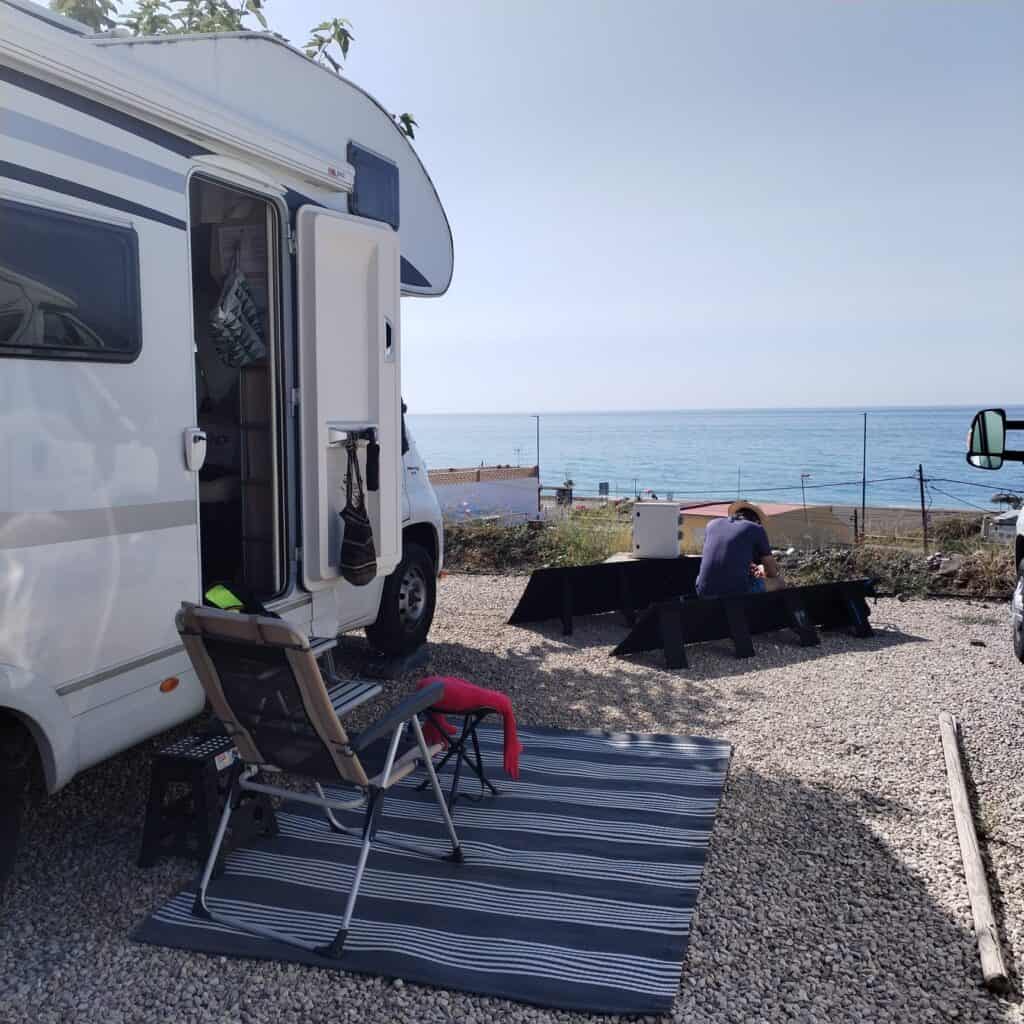
- Open 365 days a year, with the beach less than 100 m away.
- Pitches of around 50 m², XL pitches for motorhomes up to about 12 m and front-row “Balcón” pitches.
- 16 A electricity with a CEE plug, paid by metered consumption; bring a long cable, as the hook-up box can be up to 15 m away.
- Fast Wi-Fi included, professional washing machine and dryer, showers and a service point for emptying and filling.
- A small supermarket 400 m away and large ones less than 2 km away, plus a shopping service with delivery to your pitch (for a fee).
- Pets welcome, up to two per pitch (not all breeds; check the conditions).
Low season runs all year except Easter and summer, and there's a discount from 30 nights: all the details are on our rates.
Frequently asked questions
How many days does it take to drive a motorhome from Germany to southern Spain?
From central and southern Germany, five days with stages of 400 to 550 km. From Hamburg or the north, allow six. It can be done in less, but in winter it gets dark early and driving at night is far more tiring.
Is it better to go through France or Switzerland?
Through France you pay motorway tolls; through Switzerland, the annual vignette or, if your motorhome is over 3.5 t, the PSVA charge per day. From southern Bavaria, Switzerland can be worth it; from the rest of the country, the route via Alsace and Lyon is usually the most direct.
Do I need a Crit’Air sticker to cross France?
Not for driving on the motorway. You only need it if you enter a city with an active low-emission zone. If you order one, do so at certificat-air.gouv.fr, which is the only official website.
Are there tolls in Spain along the Mediterranean coast?
From La Jonquera to Alicante the AP-7 is now toll-free. Further south there are a few toll motorway sections, but always with the free A-7 as an alternative.
Can I spend the whole winter at Milucar?
Yes. Milucar is open all year and in low season there's a discount from 30 nights. Long stays are booked like any other, with a minimum of two nights.
If you already have a departure date, secure your spot at the end of the road: book your pitch at Milucar and drive straight to the sea.
 English (UK)
 Español
 Deutsch
 Nederlands
 Français
