
A motorhome service point is a spot set up for emptying grey water (sink and shower), emptying the chemical toilet (black water) and filling up with drinking water, usually with a platform with a drainage grate and a tap. There are municipal ones, private ones and some at petrol stations, as well as inside motorhome aires and campsites. Emptying anywhere else, even into a drain, isn't allowed.
In this guide we explain how to recognise a good service point, the right order to use it in, what to carry with you and what Andalusian regulations require of these facilities. If you're just starting out, it'll save you more than one headache.
What a motorhome service point is and what it has
Motorhomers use several names interchangeably: service point, dump station, borne, service bay or waste point. They all mean the same thing: a facility for the vehicle's basic upkeep. You'll usually find:
- Platform or service bay: a concrete slab sloping gently towards a central grate, where you position the motorhome to open the grey water valve.
- Black water disposal point: a dedicated basin or opening for emptying the chemical toilet cassette, often with a rinsing tap.
- Drinking water point: a tap, ideally threaded, for filling the fresh water tank.
- At some, there's also electricity paid by time and spaces to stay the night.
Some are free and some are paid (with coins, tokens or card). Since the update of the DGT's Catalogue of Signs there's also an official sign, the S-128 “Service point for caravans and motorhomes”, as noted in the DGT press release on its motorhome guidelines, so they'll be increasingly easy to spot on the road.
What the Junta de Andalucía requires of overnight motorhome areas
The Decree 26/2018 on tourist campsites sets out, for sites registered as overnight motorhome areas, a set of minimum standards that serve as a benchmark for a good service point:
- A service bay of at least 32 m², level, with a central grate of at least 1 m × 32 cm connected to the sewer or a septic tank, lighting and a standard threaded tap.
- A waste point with separate systems for grey water and black water, with a rinsing tap, and a drinking water point for the tank.
- Disposal basins with a self-cleaning or rinsing system.
That “separate system” matters: the tap where you rinse the cassette shouldn't be the one you drink from.
Grey water, black water and fresh water
| Tank | What it contains | Where to empty or fill it | Tip |
|---|---|---|---|
| Grey water | Sink, washbasin and shower | Service bay grate, by opening the valve underneath | Use a sink strainer so food scraps don't get through |
| Black water | Chemical toilet (cassette or fixed tank) | Dedicated black water disposal point, never the grey water grate if there's a separate opening | Disposable gloves and rinse with the service tap, not the drinking water one |
| Fresh water | Water for washing up, showering and, if it's in good condition, drinking | Drinking water tap | Carry your own food-grade hose and thread adaptors |
How to empty grey water step by step
Emptying grey water is the easy part, but it's worth doing it in the right order so you don't flood the platform:
- Drive onto the service bay so the tank outlet sits right over the grate. If your motorhome has the valve on one side, check beforehand which side to approach from.
- Switch off the engine and put the handbrake on.
- Open the grey water valve or tap and let it all drain out. If your model allows it, a short drain hose avoids splashes.
- When it's finished, close the valve and rinse the platform with water if anything has been left behind.

How to empty the chemical toilet without drama
The cassette is the least glamorous moment of motorhoming, but with a bit of method it takes two minutes:
- Put on disposable gloves. Always keep a pack by the cassette hatch.
- Take the cassette out through the external hatch, with the toilet lid closed inside.
- Take it to the black water disposal point, turn the spout downwards and press the air vent button (if it has one) so it empties without splashing.
- Rinse it a couple of times with the service tap and empty it again.
- Add the chemical or whatever alternative you use and a little water, following the manufacturer's instructions.
- Put it back, throw the gloves in the bin and wash your hands.
Chemicals and septic tanks
Many rural aires drain into septic tanks, which rely on bacteria. That's why more and more facilities ask for biodegradable or septic-safe products. If the aire has a sign with its rules, read it before emptying, and if not, use a product the manufacturer states is suitable for septic tanks.
Filling up with fresh water hygienically
- Use a food-grade hose for drinking water only, and store it away from the gloves and toilet kit.
- Let the tap run for a few seconds before connecting the hose.
- Carry a set of adaptors: not all taps have the same thread, and some have no thread at all.
- If the tank has been unused for a while, empty it, clean it with a water tank cleaner and refill it.
- If you're unsure whether it's drinkable, use the tank water for washing up and showering and drink bottled water.
Service point etiquette
- The service bay is for emptying and filling, not for washing dishes or the motorhome. If there's a queue, finish up and move your vehicle.
- Leave the platform and disposal point as clean as you found them.
- Don't throw in wet wipes, sanitary towels or paper that isn't soluble.
- Don't use the drinking water tap to rinse the cassette.
Why you should never empty outside an aire
As well as being a matter of respect, it's a legal one. In its motorhome guidelines, the DGT considers that a vehicle is no longer simply parked if it releases fluids outside, and the Ley de Costas (Coastal Law) gives special protection to the seashore. Dumping in the street is precisely one of the reasons some towns restrict motorhomes. Emptying in the right place helps keep the coast welcoming to us.
How often to empty and fill up
It depends on the size of your tanks and how many of you are travelling. As a practical guide:
- Grey water fills up fast if you shower on board; empty it every time you pass a service point, even if it isn't full.
- It's best to empty the cassette before the gauge shows full, especially if you're going to spend nights without facilities.
- Don't travel with a full fresh water tank if you don't need it: it's extra weight. Fill it near where you're going to sleep.
- In winter, if you're heading to areas with frost, drain the grey water and the water system when you leave the motorhome parked for several days.
Where to empty in the Axarquía: the Milucar service point
On Málaga's eastern coast there are municipal and private aires; you'll find a round-up of the nearest ones in our post on motorhome aires in and around Nerja. If you're staying at Milucar, in Torrox-Costa, you don't need to look any further: the aire has a large service bay where you can empty the grey water tank and the chemical toilet and fill up with fresh water, and drinking water taps spread around the site, so there's always one close to your pitch.
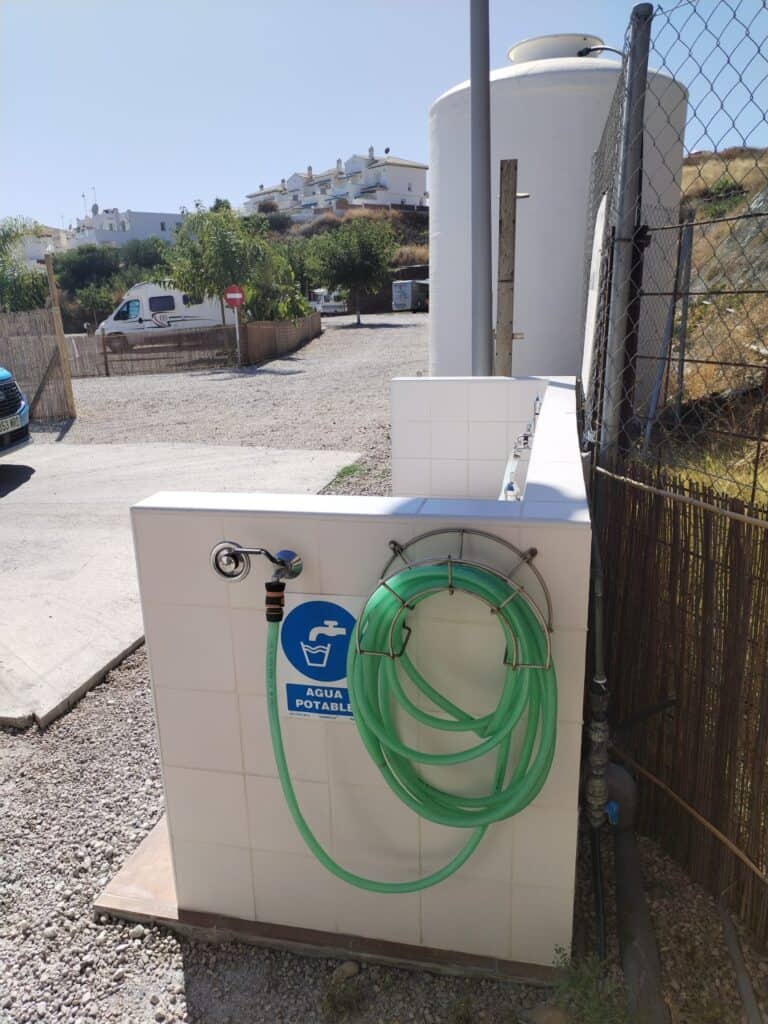
The front-row Balcón pitches have drainage and water on the pitch itself, and the XL pitches (for motorhomes up to about 12 m) share them between two, which on long stays saves you moving the vehicle to empty the grey water. You'll find the rest of the facilities (metered electricity with a CEE plug, Wi-Fi, showers, washing machine and dryer) under facilities.
How to get to Milucar
Milucar is at Avenida del Peñoncillo 61, in Torrox-Costa, next to the N-340 coast road. From the A-7, take exit 940 (Torrox/Cómpeta). It's about 7 km from Nerja (10 minutes), about 21 km from Torre del Mar (20 minutes) and about 52 km from Málaga (45 minutes). It's open 365 days a year and the beach is less than 100 metres away.
Basic service point kit
| Item | What for |
|---|---|
| Disposable gloves | Emptying and rinsing the cassette |
| Food-grade hose | Filling the fresh water tank |
| Tap adaptors with various threads | Connecting to different taps |
| Watering can or collapsible water container | Filling up where you can't connect a hose |
| Short drain hose | Directing grey water into the grate |
| Septic-safe toilet chemical | A clean, odour-free cassette |
Frequently asked questions
What's the difference between grey water and black water?
Grey water comes from the sink, washbasin and shower. Black water comes from the chemical toilet. They're emptied at different points: grey water into the service bay grate and black water into the dedicated disposal point, which usually has its own rinsing tap.
Can I empty the cassette in a public toilet?
The right thing is to do it at a service point or in the facilities of an aire or campsite. A public toilet isn't designed for it, and contents with chemicals in them can cause problems for the plumbing. If there's no other option, ask permission first.
Are motorhome service points free?
Some are and some aren't. Many municipal ones are free or charge a small amount for water; private ones and those at overnight areas usually include the service in your stay. Check the conditions of each one before you go.
Can I drink the water from the tank?
If you fill it from a drinking water tap, with a food-grade hose, and keep the tank clean, yes. If the tank hasn't been used for a while or you're unsure where the water came from, use it for washing up and showering and drink bottled water.
How do I recognise a service point on the road?
Look for the DGT's S-128 sign, “Service point for caravans and motorhomes”, or pictograms showing a motorhome with a tap. Motorhome apps list them too, but always check they're still working.
If you're looking for a base by the sea with a service point, drinking water near your pitch and the beach less than 100 metres away, we look forward to welcoming you at Milucar all year round. Book your pitch.
 English (UK)
 Español
 Deutsch
 Nederlands
 Français