
The best motorhome routes for beginners in Andalusia are short and work from a fixed base: you set up on an aire by the sea and make out-and-back trips of under an hour and a half. On the eastern Costa del Sol, for example, you can visit Nerja, Frigiliana, Antequera, El Torcal or Granada without moving on every night. That way you learn to drive, park, plug in the hook-up and empty the tanks calmly, before setting off on a touring trip.
We see it every season: people who've just got their motorhome and cram five cities into five days end up exhausted. Those who leave the motorhome on the pitch and head out on day trips come back again. Here are three easy routes from the Málaga coast and all the basics worth knowing the first time.
Why start from a fixed base
- You practise without pressure. Setting up and packing away, levelling and plugging in the hook-up just once, with time to spare and someone to ask.
- You drive less and better. Short trips on roads you get to know, with no hunting for somewhere to sleep at the end of the day.
- Services are close at hand. Grey water and chemical toilet emptying, fresh water, showers and a washing machine, without having to look for them.
- You can leave the motorhome behind. For Málaga or Granada, the bus is often easier than parking a large vehicle in the centre.

Three beginner motorhome routes from the Costa del Sol
All three start from Torrox-Costa and can be combined over a week or ten days. Distances are approximate by car; allow a little more in a motorhome.
| Route | Destinations | Distance from Torrox-Costa | Days | Driving |
|---|---|---|---|---|
| 1. Coast and white villages | Nerja, Maro, Frigiliana, Cómpeta | 7-20 km | 2-3 | Easy; narrow streets in the villages |
| 2. Inland Málaga | Antequera, El Torcal, Caminito del Rey | 96-113 km | 2 | Dual carriageway and mountain stretches |
| 3. Granada and Costa Tropical | Granada, Almuñécar, Salobreña | 30-103 km | 2-3 | Dual carriageway; Granada is best by bus |
| Extra: Málaga city | Old town, port, museums | 52 km | 1 | Best by bus |
Route 1: coast and white villages (2-3 days)
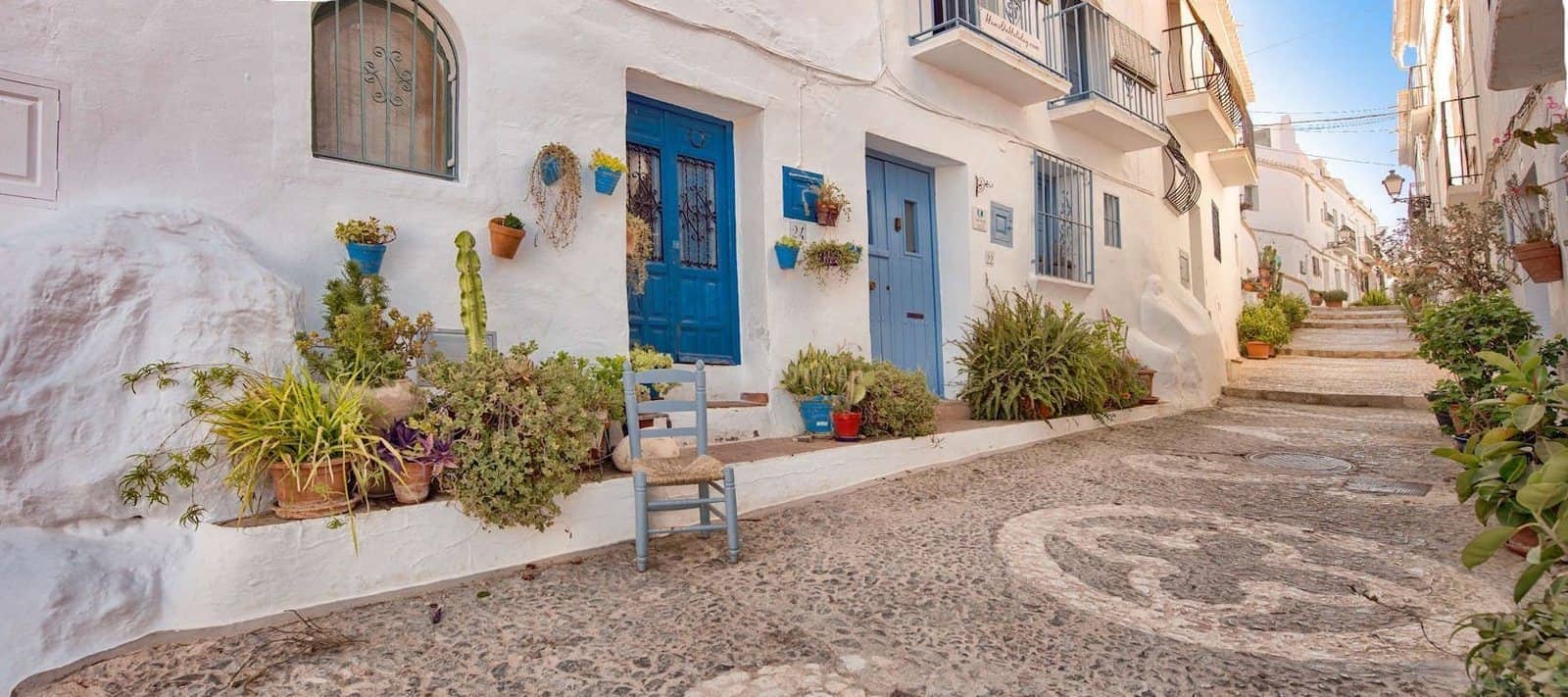
It's the easiest route and the best one to start with. Nerja is about 7 km away, Maro about 12 km and Frigiliana about 12 km, with a short mountain road up to the village. In Frigiliana and Cómpeta (about 20 km) the old-town streets are narrow and steep: leave the motorhome outside the centre and walk up. If you want to do it all in one day, you'll find the plan in Nerja, Maro and Frigiliana in a day from Torrox. Municipal information on the Frigiliana Town Council website.
Route 2: inland Málaga (2 days)

Antequera is about 96 km away, almost all on dual carriageway. There you'll find the dolmens and, a few minutes away, El Torcal, with its limestone rock formations and waymarked trails; the road up to the visitor centre is a mountain road, so take it slowly. Opening times, access and parking at Turismo de Antequera. Another day you can do the Caminito del Rey, about 113 km to the northern access: we explain how to get there by motorhome and where to park.
Route 3: Granada and the Costa Tropical (2-3 days)
Granada is about 103 km away via the A-7 and A-44, dual carriageway all the way. For a beginner, the easiest option is the ALSA bus from Torrox-Costa bus station, so you can forget about parking; if you take the motorhome, leave it outside the centre, which has a low-emission zone. Alhambra tickets are bought in advance on the official Patronato website. To the east, Almuñécar (about 30 km) and Salobreña (about 40 km) make a relaxed outing with beach and castle.
The basics before your first route
Licence, weight and speed
- With a category B licence you can drive motorhomes of up to 3,500 kg maximum authorised mass with up to eight passengers plus the driver; above that weight you need C1 (Reglamento General de Conductores). Check the registration document, not the unladen weight.
- A motorhome of up to 3,500 kg may do 120 km/h on dual carriageways and 90 km/h on ordinary roads; above that weight, 90 and 80 km/h (General Traffic Regulations).
- Write your vehicle's height, width and length on a note by the steering wheel. The DGT reminds drivers to watch out for height and width restrictions so they don't get stuck.
Parking isn't camping
According to the DGT (Spanish traffic authority) instruction on motorhomes, you can park a motorhome wherever any other vehicle could park, with people inside, as long as you don't put out an awning, tables, chairs or stabiliser legs. Putting all that out is camping, and that's only allowed on campsites and authorised aires. Local councils can also limit parking time.
Electricity: the cable and the amps
- On most Spanish and European aires the socket is CEE (the blue industrial plug). Bring your own cable with that connector and a good length: on many aires the hook-up box isn't on your pitch.
- Unroll the whole cable before using it, so it doesn't overheat.
- With 16 A at 220 V you have around 3,500 W. If you switch on a heater, kettle and microwave at the same time, the trip switch can easily go.
Water and emptying
Grey water (sink and shower) and the chemical toilet should only be emptied at a proper disposal point: a service point on an aire or campsite, or a motorway service area. Never in the street or down a drain. Fill the fresh water tank before you set off, but don't travel with everything full if you don't need to: water is heavy and counts towards the 3,500 kg.
Typical first-timer mistakes
- Planning stages that are too long. Two hours a day is plenty at first.
- Trusting the satnav in old towns. Look for parking at the entrance to the village before heading into its streets.
- Forgetting that the roof light or aerial is up before setting off.
- Setting off with cupboards open or loose items on the worktop.
- Not checking the height at underground car parks, petrol stations with canopies and bridges.
- Arriving somewhere unfamiliar after dark. Better to arrive in daylight with time to get set up.
From Milucar: a base designed for getting started
Milucar is in Torrox-Costa, on the N-340 coast road, at exit 940 of the A-7 (Torrox/Cómpeta). It's about 69 km from Málaga airport. It's run by Marcelle and Martijn, a family who live in Torrox-Costa, and reception is open every day to answer questions and tell you about the area.

- Wide access lanes and a gravel surface for easy manoeuvring; XL pitches for motorhomes up to around 12 m.
- 16 A / 220 V electricity with a CEE socket, paid by consumption on a meter. The box can be up to 15 m away: bring enough cable. You can connect it yourself or a member of staff can do it for you.
- Service point for emptying grey water and the chemical toilet and filling up with fresh water, plus drinking-water taps around the site.
- Showers (€1 coins), toilets, professional washing machine and dryer, and fast Wi-Fi included.
- Beach less than 100 m away, small supermarket 400 m away and the bus stopping right outside, on the coast road.
For days without an outing there's the long, flat Torrox-Costa seafront promenade, and Torrox village about 6 km away. If you don't have a motorhome yet, Milucar rents out a motorhome and an apartment through its page House without wheels.
Frequently asked questions
What's the best motorhome route for beginners in Andalusia?
A route with a fixed base on the coast and short outings. From the eastern Costa del Sol you have Nerja and Frigiliana less than 15 km away, Antequera less than 100 km and Granada about 103 km by dual carriageway, with no need to move on every night.
Can I drive a motorhome on a category B licence?
Yes, as long as its maximum authorised mass doesn't exceed 3,500 kg; it's shown on the registration document. Above that weight you need a C1 licence.
How many kilometres a day is it reasonable to drive at first?
Between 100 and 200 km, or about two hours. That leaves time to stop, visit and arrive in daylight. With a bit of practice, 300 or 400 km stages are no problem.
What cable do I need for the hook-up?
A cable with a CEE connector, the blue industrial plug, and a good length. At Milucar the box can be up to 15 m from your pitch, so it's worth bringing at least that length.
Where do I empty grey water and the chemical toilet?
Only at authorised disposal points: service points on motorhome aires and campsites, or motorway service areas. At Milucar there's a large service point for emptying and filling up with fresh water.
If it's your first trip, take it easy and keep the sea right next to you: book your pitch at Milucar and start with the short routes.
 English (UK)
 Español
 Deutsch
 Nederlands
 Français
