
If you're wondering what to see in Nerja in a day, the best plan is to combine it with its two neighbours: start early at the Cueva de Nerja and Maro, head down to the centre and the Balcón de Europa for lunch, and finish the afternoon in Frigiliana, about 6 km from Nerja. From Torrox-Costa everything is less than 20 minutes away by car, so there's time to see it all without rushing and get back to base for the night.
This is the route we usually recommend to guests staying a few days in the area who want to make the most of a full day. We'll tell you the order, the timings, where to leave your vehicle and what changes depending on the time of year.
The day's plan at a glance
The order matters. The cave opens early and, according to its own website, the quietest time slot is from 10:00 to 11:30. Frigiliana, on the other hand, is at its best in the afternoon light and with less heat on its steep streets. That's why we suggest this route from east to west and then back up into the hills:
| Approx. time | Stop | What to do | Time |
|---|---|---|---|
| 9:30 | Cueva de Nerja | Cave visit (about 50 minutes) and a walk around the grounds | 1 hr 30 |
| 11:30 | Maro | Iglesia de las Maravillas, sugar mill, Acueducto del Águila, beach viewpoint | 1 hr |
| 13:00 | Nerja centre | Balcón de Europa, El Salvador church, Calahonda beach and lunch | 3 hrs |
| 16:30 | Frigiliana | Morisco quarter, Calle Real, El Ingenio and viewpoints | 2-3 hrs |
| 19:30 | Back to Torrox-Costa | About 20 minutes via the A-7 | – |

From Milucar: getting around during the day
Milucar is on the N-340 coast road in Torrox-Costa, and all three stops are very close. These are the driving distances from the aire (allow a little longer in a motorhome):
- Nerja centre: about 7 km, 10 minutes.
- Cueva de Nerja: about 11 km, 15 minutes.
- Maro: about 12 km, 18 minutes.
- Frigiliana: about 12 km, 20 minutes.
With the motorhome or without?
Our advice is to leave the motorhome hooked up on your pitch and do the route by car, motorbike or public transport. Much of Nerja's centre is pedestrianised and the municipal car park at the Balcón de Europa is underground, designed for cars. Frigiliana's old town has narrow, steep streets. And space is limited in Maro too: Nerja Town Council opened a 100-space surface car park at the western entrance to the village to manage traffic, especially in summer.
If you're in a small campervan or a motorhome, the easiest stop is the cave itself: its grounds have a paid car park for cars, motorbikes and caravans, open only during visiting hours, so it's no good for an overnight stay.
By bus
The bus stops right outside Milucar on the coast road, and ALSA buses run from Torrox-Costa station to Nerja (the journey takes around a quarter of an hour). The cave itself says there are buses marked “Nerja (Cuevas)” that stop next to the site, and there's also a bus from Nerja to Frigiliana. Timetables change with the season: check them at alsa.es or at the tourist office before you set off.
First stop: the Cueva de Nerja
The Cueva de Nerja was discovered by five local lads on 12 January 1959 and opened to the public in June 1960. Today it is a listed Site of Cultural Interest and receives hundreds of thousands of visitors a year. The tourist route takes you through the Vestibule, Nativity, Waterfall (or Ballet), Ghosts and Cataclysm chambers, with their huge fallen columns.
- The visit lasts about 50 minutes and involves 458 steps, up and down.
- Pets are not allowed inside, except guide dogs.
- Online tickets are cheaper and give you a time slot; the audio guide is a free app that's best downloaded beforehand.
- The ticket includes the Museo de Nerja, in the town centre.
Opening hours, prices and closing days are on the official Cueva de Nerja website; check it before you go, as they change through the year.
Maro, between the fertile plain and the cliffs
A stone's throw from the cave is Maro, a hamlet belonging to Nerja that looks out over the fertile plain and the Acantilados de Maro-Cerro Gordo nature area. You can walk round it in no time, and it has more history than it first appears.

- Iglesia de Nuestra Señora de las Maravillas: a church in vernacular style completed in the late 17th century. Maro's festivals are on 17 January (San Antón) and 8 September (Virgen de las Maravillas).
- Ingenio de Maro: the remains of the sugar mill set up by Felipe de Armengol after he bought the estate in 1582. It ran until a fire stopped it in the 19th century.
- Acueducto del Águila: late 19th century, with four tiers of brick arches and around 52 metres high. You get a great view of it from the road, next to the Coladilla ravine.
- Playa de Maro: about 500 metres of dark sand below the cliffs. You walk down, and in high season there's a shuttle bus because you can't drive down.
If you're going in summer and fancy a swim, bear in mind the beach fills up early. On a day like this, with so many stops, it may be better just to look down from the viewpoint and save the swim for another day.
What to see in Nerja in a day: the centre and the Balcón de Europa
Head back to Nerja around midday, park the car and lose yourself in the centre. Many of its streets are pedestrianised and everything is just a few minutes' walk from the Balcón de Europa.

- Balcón de Europa. A clifftop viewpoint between Calahonda and La Caletilla beaches, where a fortress, the Castillo Bajo, was built in the early 16th century and destroyed during the Peninsular War. Leaning on the railing is the statue of King Alfonso XII, who visited Nerja after the earthquakes of 1884.
- El Salvador church. Between the Balcón and Plaza Cavana, with a Mudéjar coffered ceiling and, in front of the door, a century-old monkey puzzle tree brought from Chile by an emigrant from Nerja.
- Playa de Calahonda. Small, with fishing boats, and for many the most photographed spot in Nerja. You reach it by a staircase from the end of Calle Puerta del Mar.
- Paseo de los Carabineros. From Calahonda, a walkway runs below the Balcón to El Salón beach.
- Museo de Nerja. If you have half an hour to spare, your cave ticket includes it.
There are plenty of places to eat in the centre and by the beaches. If you'd rather have a long beach to relax on after lunch, Burriana, with around 800 metres of sand, is a short walk from the centre.
Afternoon in Frigiliana
From Nerja it's just a few minutes up to Frigiliana on the MA-105. The village sits at about 300 metres above sea level, inside the Sierras de Tejeda, Almijara y Alhama Natural Park, and looks down over the sea.

- El Barribarto: the old quarter of Morisco-Mudéjar origin, a listed historic-artistic ensemble. Winding streets, narrow alleyways and whitewashed façades.
- The ceramic panels: twelve plaques spread across the façades telling the story of the Morisco uprising and the battle of the Peñón de Frigiliana.
- El Ingenio: the former palace of the Manrique de Lara family, turned into a cane-syrup factory.
- Calle Real and the church of San Antonio de Padua: the village's shopping street and its church from 1676.
- Fuente Vieja: from around 1640, bearing the coat of arms of the first Count of Frigiliana.
The tourist office is in the Casa del Apero, next to the Archaeological Museum, and they'll give you a street map there. Take the climb slowly, drink water and head for the viewpoints on Callejón del Peñón or Calle Santo Cristo for sunset.
How to adapt the route to the season
- Summer: more people and more heat. Buy your cave ticket online, get to Maro early and leave Frigiliana until the sun goes down. In late August the village hosts the Frigiliana 3 Cultures Festival and is packed.
- Autumn, winter and spring: the best time for this route. There are fewer people, the temperature is right for walking and parking is easier.
- With a dog: dogs can't go into the cave, so you can start directly with Maro and Nerja. For a run off the lead, Torrox-Costa has the dog beach next to the lighthouse.
- With children or reduced mobility: the cave's 458 steps and Frigiliana's slopes take their toll. Cut down the stops and stick to the centre of Nerja.
Back to base in Torrox-Costa
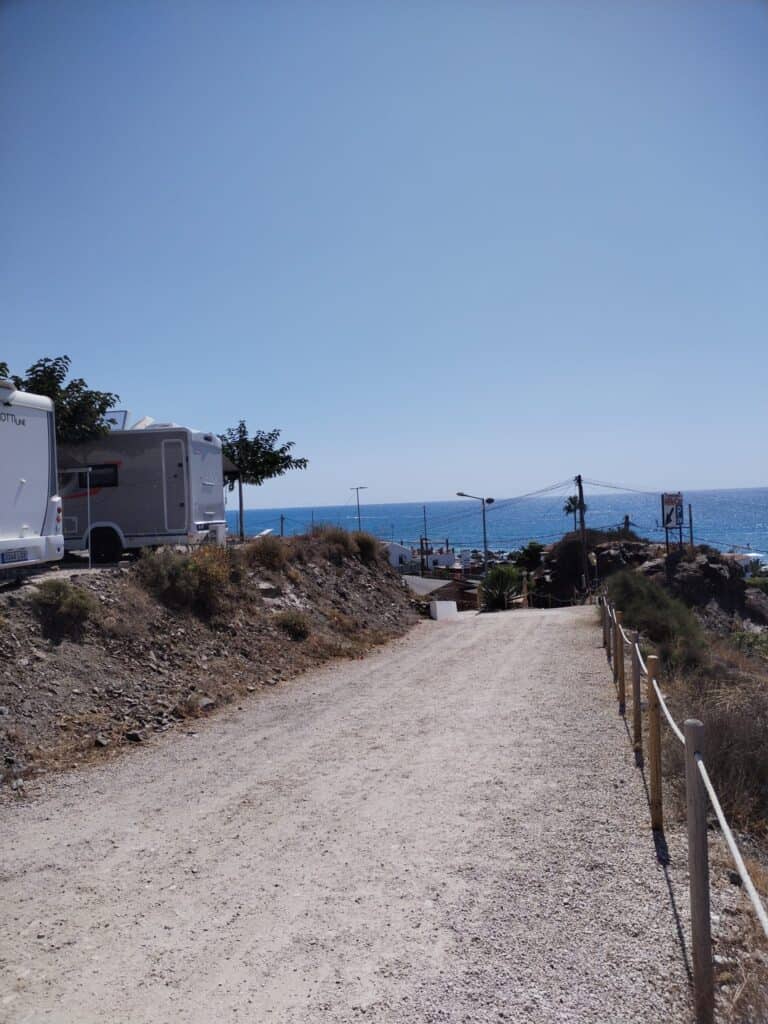
The great thing about doing this trip from Milucar is that it's only 20 minutes back to a pitch less than 100 metres from the beach, with showers, Wi-Fi included and a laundry for the next day. Remember that the vehicle gate closes at 20:00; if you'll be back later by car, plan ahead (the pedestrian entrance works with a code).
If you're staying for several days, Torrox deserves a day of its own too: we cover it in what to see in Torrox, the village and the coast. And our page on the area has more ideas for getting around the Axarquía.
Frequently asked questions
Is there time to see Nerja, Maro and Frigiliana in a single day?
Yes, if you start early. The three stops are less than 20 minutes from each other and the plan leaves about three hours for Nerja and two or three for Frigiliana. What there isn't time for is a long afternoon on the beach as well.
What's unmissable in Nerja if I only have a few hours?
The Balcón de Europa, Calahonda beach and El Salvador church, which are just a few metres from each other. If you have a bit more time, add the Cueva de Nerja, about 3 km from the centre.
Can I do the route in my motorhome?
You can, but it's not the easiest option. Space is limited in the centre of Nerja, in Maro and in Frigiliana's old town. It's better to leave the motorhome at the aire and get around by car, motorbike or bus.
Do you need to book the Cueva de Nerja?
It's not compulsory, but the cave itself recommends buying online: it's cheaper, you skip the queues and you get a fixed time. In summer and on long weekends it's worth booking ahead.
How do I get to Nerja by public transport from Torrox-Costa?
With ALSA buses, which leave from Torrox-Costa station and take around a quarter of an hour. From Nerja there are connections to the cave and to Frigiliana. Check current timetables on the ALSA website.
If you want to do this route at your own pace and come back to the sea every night, book your pitch at Milucar and use it as your base for exploring Nerja, Maro and Frigiliana without moving the motorhome.
 English (UK)
 Español
 Deutsch
 Nederlands
 Français
