
The motorhome route from France to Andalusia along the Mediterranean coast crosses the border at La Jonquera and heads down through Catalonia, the Valencia region, Murcia and Almería to the Costa del Sol. From Perpignan it's about 1,120 km to Torrox-Costa and from Montpellier about 1,270 km: comfortable in four to six short stages, almost always with the sea in sight. The AP-7 is toll-free between the border and Alicante, and from there you carry on along the A-7 dual carriageway.
In France people search for it as camping-car Espagne, and most of those who write to us from there want the same thing: to come down without rushing, sleep by the sea and reach the south with time to stay. Here you have the distances, a breakdown of stages, the stops worth making and the Spanish rules that most surprise people on arrival.
Distances from France to the Costa del Sol
| Exit | Distance to Torrox-Costa | Non-stop driving |
|---|---|---|
| Paris | about 1,785 km | about 19 hrs |
| Lyon | about 1,570 km | about 17 hrs |
| Toulouse | about 1,310 km | about 14 hrs |
| Montpellier | about 1,270 km | about 14 hrs |
| Carcassonne | about 1,230 km | about 13 hrs 20 |
| Perpignan | about 1,120 km | about 12 hrs 20 |
These are road distances by car; with a motorhome allow a bit more time, especially on the mountain sections.
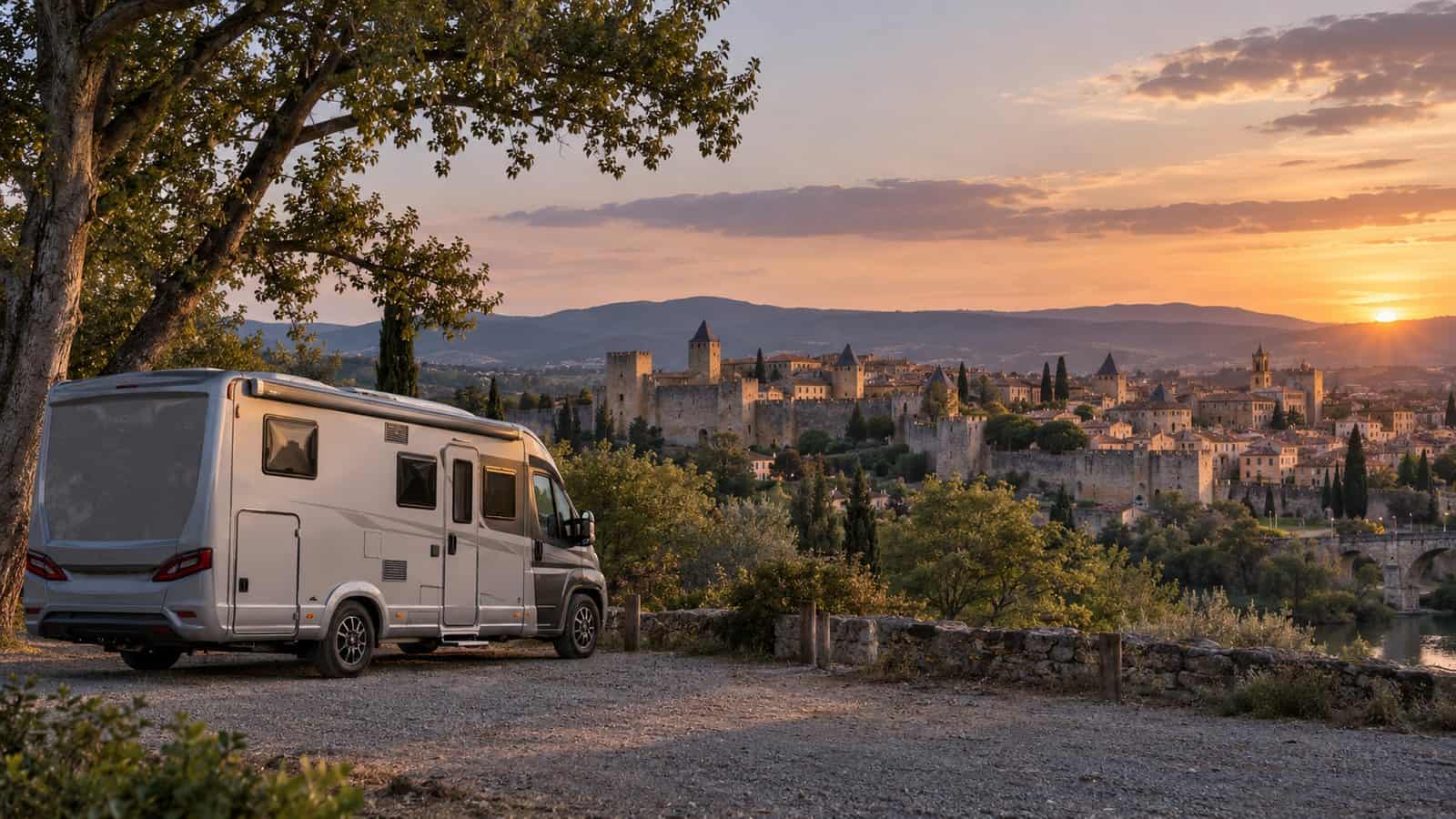
Before the border: Carcassonne and Collioure
If you're coming via Toulouse or Montpellier, the last French stretch is good for two very different stops.
Carcassonne

The walled medieval Cité is about 95 km from Toulouse and about 150 km from La Jonquera. It's a classic stop for the first or last night in France. The tourist office publishes on its official website opening hours, access and parking.
Collioure
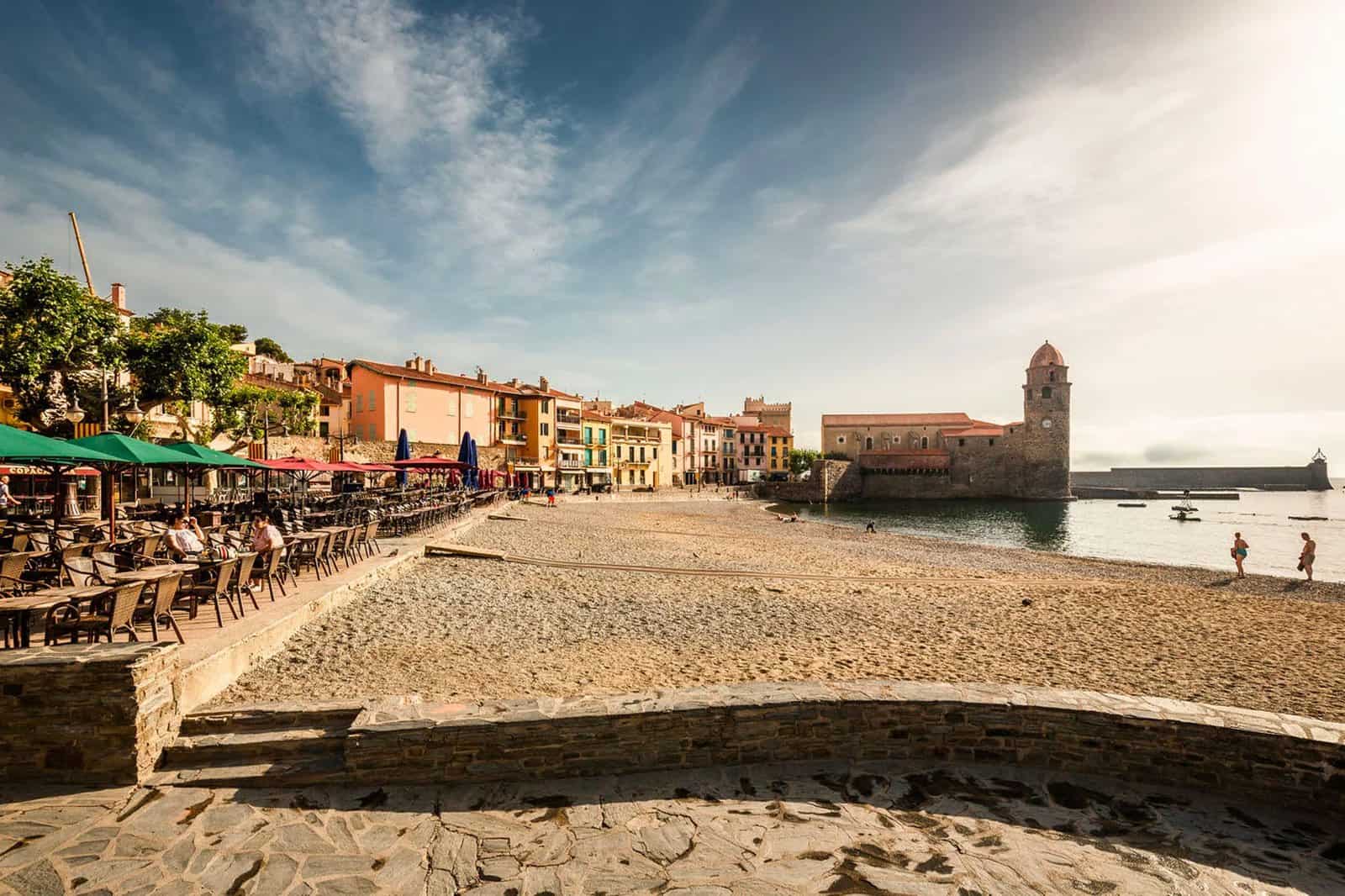
On the Côte Vermeille, a few kilometres from the border, Collioure is a fishing village with its church right by the water and a royal castle. The centre is small and gets crowded: go early or out of season. Information from the Collioure tourist office.
The motorhome route from France to Andalusia, stage by stage
A plan in six short stages from La Jonquera, driving in the morning and having the afternoon free:
- La Jonquera – Tarragona: about 245 km (2 hrs 45). You pass close to Girona and Barcelona; Tarragona has a Roman ensemble listed as a World Heritage Site.
- Tarragona – Valencia: about 255 km (2 hrs 55). Halfway along are the Ebro Delta and Peñíscola.
- Valencia – Alicante: about 180 km (2 hrs). Costa Blanca beaches.
- Alicante – Murcia: about 80 km (1 hr). A short stage to rest, or carry on to the Mazarrón coast.
- Murcia – Almería: about 220 km (2 hrs 30). Right next door, the Cabo de Gata-Níjar Natural Park.
- Almería – Torrox-Costa: about 160 km (1 hr 55), via the Costa Tropical.
In total, about 1,140 km from the border. If you're in a hurry, it can be done in four days by combining stages; if you're coming to spend the winter, there's no reason to rush.
Four stops on the Spanish coast
Peñíscola
A walled old town on a peninsula, with the castle at the top and beaches on both sides. About 150 km north of Valencia, it works well as a first long night in Spain. Information on the Peñíscola tourism website.
The Ebro Delta
Between Tarragona and Castellón: rice fields, lagoons and wide-open beaches, with flat roads and quiet villages. In winter it's a haven for birds and there's hardly anyone around.
Cabo de Gata
Once in Almería, the Cabo de Gata-Níjar Natural Park is volcanic coastline, dry and almost undeveloped. San José is about 40 km from Almería city. The park has its own rules, stricter than the general ones: on beaches, dunes and restricted areas you can't park or spend the night outside the designated spaces, and this is enforced.
The Costa Tropical
Between Almería and Málaga, the A-7 passes Motril, Salobreña and Almuñécar, now in the province of Granada, with custard apple and avocado trees on the slopes. Almuñécar is about 30 km from Torrox-Costa: a good place to stop for lunch before you arrive.
Spanish rules worth knowing
- Speed limits. A motorhome up to 3,500 kg can do 120 km/h on motorways and dual carriageways and 90 km/h on ordinary roads; above 3,500 kg, 90 and 80 km/h (General Traffic Regulations, art. 48).
- Bike racks and rear loads. If the load sticks out at the back, in Spain it must be marked with the red-and-white striped V-20 panel (art. 15 of the same regulation). Many foreign drivers don't have one.
- Parking is not camping. The DGT instruction on motorhomes treats a parked motorhome like any other vehicle, as long as you don't put out an awning, tables or stabiliser legs. Camping is regulated by the autonomous communities, and town councils can limit parking time.
- Tolls. The AP-7 has been toll-free between La Jonquera and Alicante since 2020 and 2021 (Spanish Government). Further south there are still some toll sections, always with the free A-7 as an alternative.
- Low-emission zones. Many Spanish cities have them, and the DGT sticker isn't issued to foreign vehicles. Check the local by-law before entering a town centre and, as a rule, park outside.
And before leaving France: on the autoroutes, a motorhome over 2 m and under 3 m high and up to 3.5 t pays class 2, and at 3 m or more, or over 3.5 t, class 3 (Vinci Autoroutes). If you enter a city with a ZFE (low-emission zone), you'll need the sticker from certificat-air.gouv.fr.
Where to sleep along the way
On the Spanish Mediterranean coast there are campsites and motorhome areas at almost every stage, but in high season and in the most popular winter months they fill up. Two tips: book the nights that matter most to you and always have a plan B noted down. If you'd like to see options by the sea, there's a selection in our guide to motorhome areas by the sea in southern Spain.
From Milucar: the end of the route
Milucar is in Torrox-Costa, on the N-340 coast road, at exit 940 off the A-7 (Torrox/Cómpeta). From Almería it's about 155 km and from Perpignan about 1,120 km. The entrance gate closes at 20:00, so plan the last stage with time to spare.
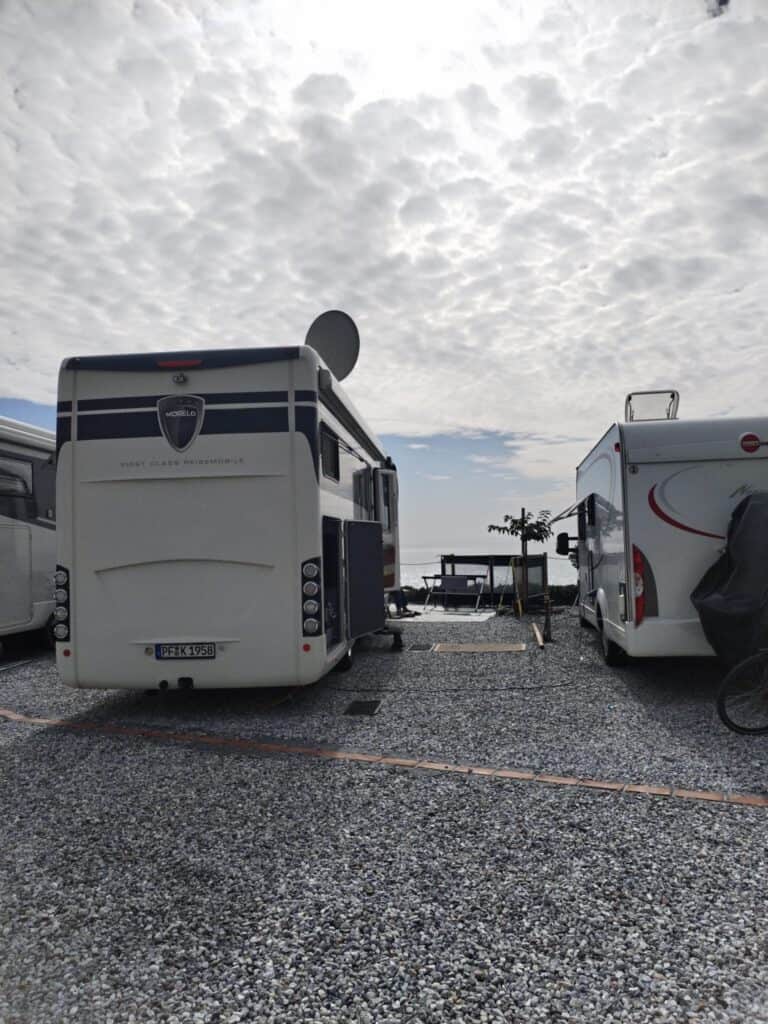
- Beach less than 100 m away, flat seafront promenade and Torrox-Costa centre about 2 km away.
- Gravel pitches of about 50 m², XL pitches for motorhomes up to about 12 m and front-row “Balcón” pitches.
- 16 A electricity with a CEE socket (bring your own cable; the box may be up to 15 m away), paid by consumption.
- Service point for emptying and filling, fast Wi-Fi included, professional washing machine and dryer, and showers.
- Pets welcome, up to two per pitch; there's a dog beach next to the Torrox lighthouse.
Open 365 days a year. Low season lasts all year except Easter and summer, with a discount from 30 nights (see the rates). If you're coming for several weeks, our page on long stays at Milucar explains how they work.
Frequently asked questions
How many kilometres is it from the French border to Andalusia?
From La Jonquera to Almería, about 930 km, and to Torrox-Costa, on the eastern Costa del Sol, about 1,085 km along the coast. It takes four to six days without driving more than three hours a day.
Do you have to pay tolls in Spain?
Between the border and Alicante, no: the AP-7 is free. Further south there are some toll motorway sections, but the A-7 dual carriageway runs parallel and is free.
Do I need a special sticker or plate to drive in Spain?
You don't need a vignette for the motorways. If you carry a bike rack or a load that sticks out at the back, you need the V-20 panel. To enter low-emission zones, check each city's by-law.
Can I sleep in the motorhome outside a campsite?
You can park wherever a car could and sleep inside, as long as you don't put out an awning, tables or levelling blocks. But many town councils limit the time or ban camping, so keep an eye on the signs.
When is the best time to drive down?
From October to March to winter in the sun; in spring and autumn if you're after mild temperatures for sightseeing. In summer the coast is packed and it's best to book every night.
Once your stages are planned, book the end of the trip by the sea: book your pitch at Milucar.
 English (UK)
 Español
 Deutsch
 Nederlands
 Français
