
The Cueva de Nerja is in Maro, about 3 km from Nerja town centre, and can be visited all year except on four days: the visit takes about 50 minutes, it opens at 9:15 and there's paid parking on site for cars, motorbikes and caravans. It's worth buying your ticket online, which is cheaper and gives you a set time, and arriving early: the quietest slot is from 10:00 to 11:30.
From Torrox-Costa it's about 15 minutes by car, so it's one of the easiest day trips if you're staying in the area. Here's how to get there, where to leave the motorhome, what the route is like and what to bear in mind before you go.
What the Cueva de Nerja is
It's a large cave formed in the marble of the Sierra Almijara. According to the foundation that runs it, water began dissolving the rock more than five million years ago and some of its formations are over 800,000 years old. It extends for 4,823 metres and has three entrances, although only part of it is open to the public.
It was discovered by five young people from Nerja on 12 January 1959, when they squeezed through a narrow opening used by bats in a small cavity known as Las Minas del Cementerio. The cave opened on 12 June 1960 with a ballet performance in the Cascada chamber, the origin of its music festival. It is listed as a Site of Cultural Interest, in the Archaeological Zone category, and receives more than 400,000 visitors a year.
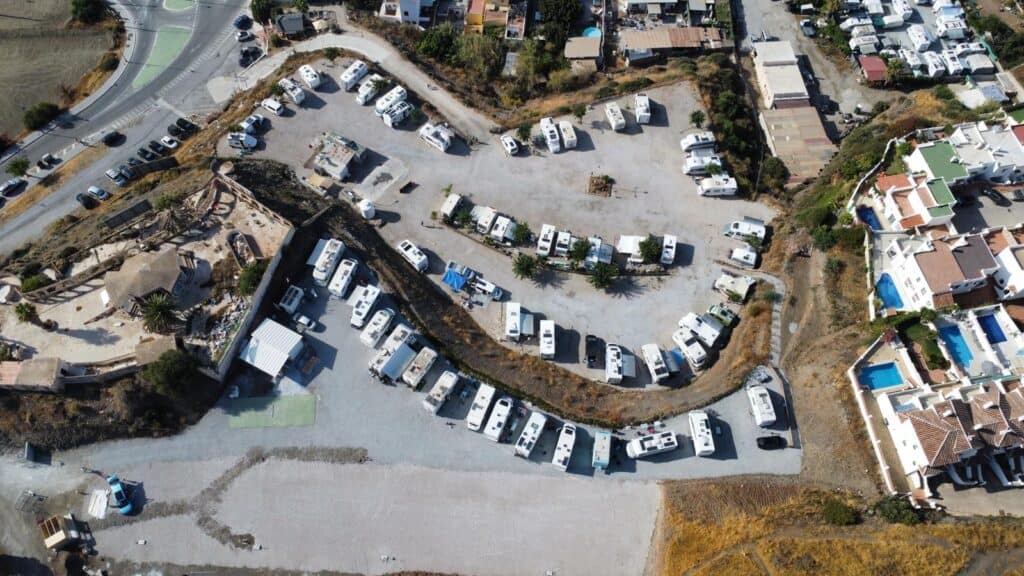
From Milucar: how to get there and where to park
The address is Carretera de Maro s/n, in Maro (Nerja). From Milucar it's about 11 km and about 15 minutes on the A-7 towards Almería/Granada; allow a little longer in a motorhome. The cave is signposted from the motorway and from the N-340.

Parking at the Cueva de Nerja
- On site: there's a large car park for cars, motorbikes and caravans, plus bike parking.
- It's charged by the minute. The rates are published on the cave's website and at the ticket office; the first 90 minutes cost slightly more per minute than the rest.
- Only during opening hours. The cave itself makes clear that the car park closes with the site, so it's no good for an overnight stay.
If you're in a motorhome, it's one of the few places in the area where parking for a visit isn't a problem. Even so, arrive early in summer and at Easter: it fills up by mid-morning.
By bus
The bus stops right outside Milucar, on the coast road, and ALSA buses to Nerja leave from the Torrox-Costa bus station. The cave has its own stop: buy tickets to «Nerja (Cuevas)», both from Nerja and from Málaga. From Nerja there's also a tourist train with a combined ticket option. Check current timetables at alsa.es and on the Cueva de Nerja's getting-there page.
Opening times and tickets
The cave works with two periods. These are the opening times published on its official website; they may change, so check them at cuevadenerja.es before you go.
| Period | When | Opening times | Last entry |
|---|---|---|---|
| Period 1 | Rest of the year | 9:15 to 16:30 | 15:30 |
| Period 2 | June to September, Christmas, bank holiday weekends and Easter | 9:15 to 17:30 | 16:30 |
| Closed | 1 and 6 January, 15 May and 25 December | – | – |
How to buy your ticket
- Online: on the cave's ticketing website. It isn't compulsory, but it's cheaper, you skip the queue and the ticket comes with an entry time. Just show the QR code on your phone.
- No changes or refunds: choose your day and time carefully.
- Discounts: there are reduced rates for over-65s, people with disabilities, European Youth Card holders and large families with a Spanish large-family certificate. You have to show proof at the entrance.
- Museum included: your ticket gives access to the Museo de Nerja, in the town centre, with finds from the cave and replicas of its paintings.
What the Cueva de Nerja visit is like
The tourist route passes through the Vestíbulo, Belén, Cascada (or Ballet), Fantasmas and Cataclismo chambers. You follow lit walkways and steps at your own pace, with the audio guide on your phone.

- Duration: about 50 minutes.
- Steps: 458, with several changes of level. There are two rest areas with benches.
- Audio guide: it's a free app, in 15 languages, with a children's version in Spanish and English. Download it beforehand, at home or on your pitch using the Wi-Fi.
- Pets: not allowed, not even in a carrier, except guide dogs.
- Health: the cave doesn't recommend it for people with reduced mobility or heart problems, and it may feel oppressive if you suffer from claustrophobia.
The Cataclismo chamber is striking for its columns and fallen blocks. The foundation explains that they collapsed in a palaeo-earthquake about 800,000 years ago.

If you can't go down into the cave
On site there's a virtual reality room with a 360º simulation. As well as serving those who can't do the route, it shows features you don't see on the visit for conservation reasons, such as the cave art.
Facilities on site
The visit can easily be stretched out. This is what you'll find outside the cave:
- Restaurant-café with views of the sea, the botanical garden and Maro.
- Gift shop, information point and photo service.
- Lockers (€1, refunded when you finish).
- Picnic area, children's playground, baby-feeding room and accessible toilets.
- Next door is the Jardín Botánico Detunda-Cueva de Nerja.
The Music and Dance Festival
Since the 1960 opening, the cave has held its Music and Dance Festival every year, with concerts inside the cave. The programme and tickets are published on the official website; the dates vary, so check them in good time if you're interested.
Tips for your visit
- Go first thing. The cave says it's quieter from 10:00 to 11:30.
- Buy online in summer, at Easter and on bank holiday weekends.
- Comfortable shoes with good grip, because of the steps.
- If you're travelling with a dog, plan ahead: it can't go in, and in summer it's not a good idea to leave it in the vehicle.
- Combine the visit with Maro and Nerja town centre in the same morning.
What to see near the cave
The cave is at the entrance to Maro, a small village with its church of Las Maravillas, the remains of its sugar mill and, a little further on, the Acueducto del Águila. Below the village is Playa de Maro, which you walk down to. And on the way back towards Torrox, it's worth stopping at the Balcón de Europa and Nerja town centre, about 3 km away.
Afterwards, you're back at Milucar in 15 minutes, with the beach less than 100 metres from your pitch for the rest of the afternoon.
Frequently asked questions
How long does the Cueva de Nerja visit take?
The route takes about 50 minutes. If you add parking, the shop and a coffee on site, allow between an hour and a half and two hours.
Can you park a motorhome at the Cueva de Nerja?
Yes. The on-site car park takes cars, motorbikes and caravans and is charged by the minute. It's only open during visiting hours, so you can't stay overnight there.
Do you need to book tickets?
It isn't compulsory, but it is recommended. Online, the ticket is cheaper, has a set time and you skip the queue, which you'll appreciate in summer.
Are dogs allowed in the Cueva de Nerja?
No, not even in a carrier, for hygiene and conservation reasons. Only guide dogs are allowed.
Is it suitable for children and older people?
Children love it and there's a children's audio guide. With 458 steps and the changes in level, it isn't recommended for people with reduced mobility or heart problems; the virtual reality room is there for them.
Which days is the Cueva de Nerja closed?
According to its website, it's closed on 1 and 6 January, 15 May and 25 December. The rest of the year it's open every day.
If you'd like to visit the cave without rushing and have the beach right there when you get back, book your pitch at Milucar, in Torrox-Costa, a quarter of an hour from Nerja.
 English (UK)
 Español
 Deutsch
 Nederlands
 Français
